

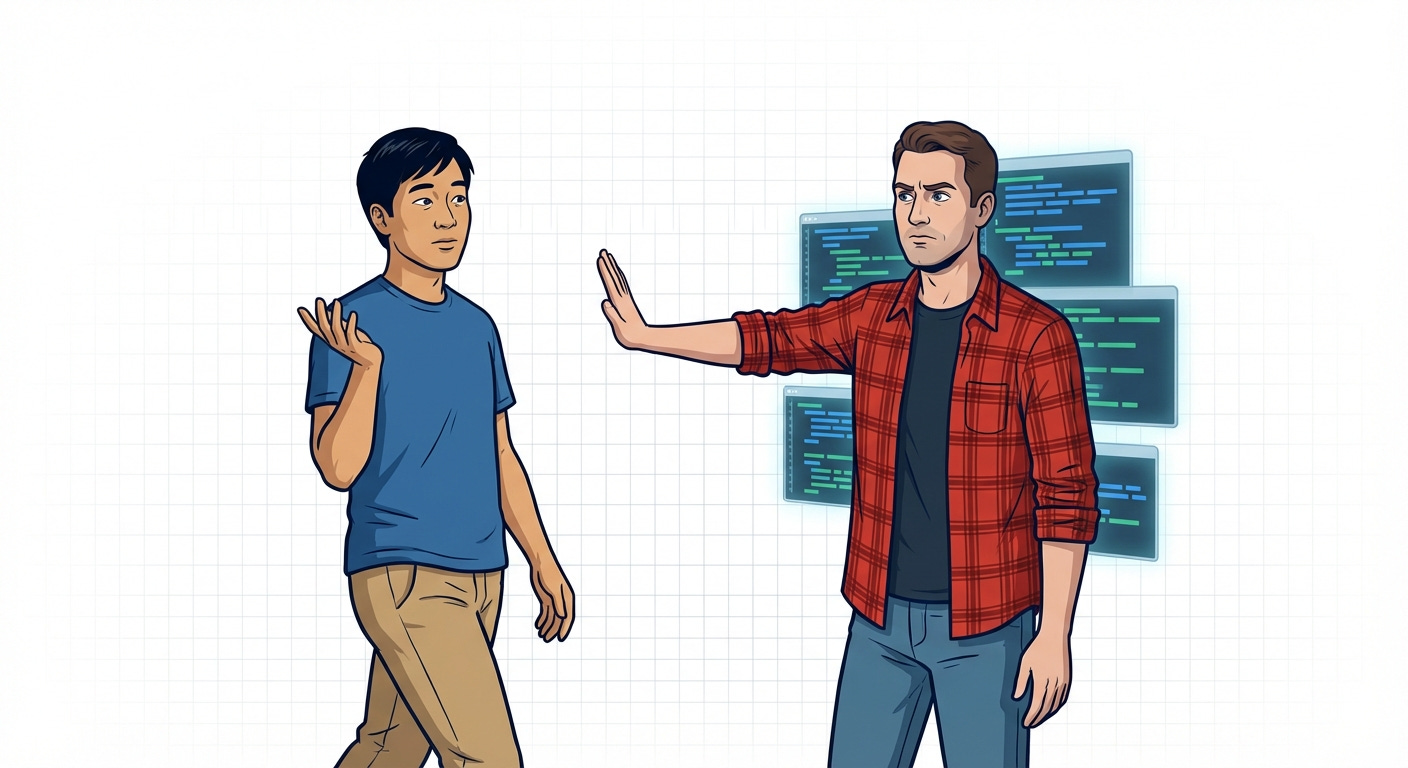
An engineer I work with noticed a reliability issue in a system owned by another team. They dropped into their Slack channel, flagged the problem, and offered a concrete fix. The response was fast: the system owner picked apart their suggestion, dismissed the approach, and closed the thread. The issue stayed open for months.
Similarly, in the past, I made myself a blocking reviewer on certain types of PRs because I didn’t trust anyone else to do the right thing. I didn’t use the word “territorial” at the time. I told myself it was about quality. What was actually happening: I was slowing everyone down because I was afraid someone would mess up, and I couldn’t find a better way to prevent that (e.g., teaching people).
I was, for all intents and purposes, territorial. I felt like I had to protect rather than share. Block rather than open. Restrict rather than expand. And that's what territorial behavior is: treating something as yours to protect rather than yours to share.
Territorial behavior is one of the most common collaboration problems in Tech, and one of the least named. Because nobody thinks of themselves as territorial. Yet most of us have been territorial at some point, or have been on the receiving end.
So what do we do about it? In this article, we’ll cover:
How territorial behavior shows up
What causes territorial behavior
What to do when others are being territorial
What to do when you’re the territorial one
Why this matters in 2026 more than ever before
First, a word from today’s sponsor:
The old adage of “what gets measured gets improved” is more true than ever. In fact, when it comes to AI dev tool rollouts, I’m seeing a lot of companies wanting to improve their AI adoption and productivity, but still struggling to even measure it.
The latest AI Engineering Trends report from Jellyfish finds that top AI adopters are reaping the benefits, with PR throughput doubling and 8% coming from autonomous agents. You could be one of them.
It’s time you measured your AI adoption and impact - and started seeing the gains.
How territorial behavior shows up
Territorial behavior can show up in many ways. Here are some of the most common examples I see in engineering teams.
Shutting down ideas before they get a fair hearing. “That won’t work.” “No, we’re not going to go this route.” “That’s not how we do it here.” Sometimes the dismissal is blunt. Sometimes it’s dressed up as a technical objection while the real resistance stays unspoken: this would take away scope, and I don’t want it to. And sometimes it’s subtler. The same idea lands differently depending on who brings it, and the people doing it may not even realize it.
Gatekeeping knowledge. Having only one person who understands how something works. Sparse documentation. Slow onboarding. Critical tribal knowledge that lives in one person’s head and nowhere else. Context that travels by Slack DM and never makes it to a wiki. The knowledge gap resulted from not making knowledge sharing a priority. Over time, that gap became a moat. If there are things only I know, I stay essential.
Gatekeeping information flow and decision-making. This happens when all information, decisions, deployments, or escalations in a particular area have to go through one person. It looks like thoroughness, safety, and rigor, but ends up becoming a way of control. If everything runs through me, I stay essential.
Other examples include: lack of transparency about roadmaps or priorities, excluding people from relevant meetings, or resisting cross-team collaboration on shared problems.
What causes territorial behavior
In my experience coaching engineers and leaders, it usually comes down to one of these things.
Lack of trust. Sometimes, territorial behavior is less about a specific idea and everything to do with the person bringing it. Do they understand the context? Will they break something I’ll have to fix? Will they get the credit while I clean up the mess? The less you trust those stepping into your territory, the harder you defend it.
Perceived lack of control. Reorgs, shifting priorities, new tools, new people. When everything around you is changing, and you can’t control any of it, guarding your domain makes you less vulnerable. If no one else can touch it (or knows how to), no one else can take it away, no?
Being burned in the past. You let someone else own a migration, and it caused an incident. You shared an idea for a re-architecturaland watched someone else present it at the design review (and get credit for it). After enough of that, territorial behavior becomes scar tissue: the last time I caved, it went badly.
Job security. This one sits underneath all the others. When you’ve been the expert on something for years, anyone stepping into that space feels like a threat. The proposal itself is secondary. The question underneath is what stings: am I still the person who matters here?
And sometimes it's just overwhelm. When you're already stretched thin, someone stepping into your area feels like one more thing to manage. The instinct to push back can also simply be about capacity.
What to do when others are being territorial
You can’t prevent someone from being territorial, but you can be thoughtful about your approach when entering their space.
Lead with curiosity. Before you propose anything, ask questions. “How does this work today? What have you tried? What am I missing?” Curiosity signals respect for the context they’ve built. It also helps you understand what you’re actually walking into before you start suggesting changes.
Do your homework. Show you’ve engaged with their domain before you show up with opinions. Read the docs. Understand the history. If you’re proposing something in someone else’s area and you haven’t bothered to learn how it works today, you’ve already lost them. Doing the work upfront is how you earn trust.
Be transparent about what you want. Are you trying to help? Suggest a different approach? Flag a concern? Say it upfront. People are much more open to input when you’re being upfront and with good intentions.
Include them early and give them a real role. Don’t ambush them with a proposal they’re hearing for the first time. Don’t route around them because they’re difficult. Bring them in before decisions are made, and give them a job in the conversation: “I’d love your input on the tradeoffs here” or “you’d be the right person to flag if we’re missing something.”
Name the problem, not the person. “I’m noticing it’s hard to get visibility into this part of the system. Can we figure out a better approach?” is an opening. “You’re being territorial” is a fight.
Enjoying this article? Hit the ❤️ button or share it with a friend or coworker. 🙏🏻
What to do when you’re the territorial one
The advice above works if you’re dealing with someone who has a pattern of being territorial. But what about yourself? What if you’re starting to feel territorial? Here’s how to handle that.
Get curious before getting defensive. When someone steps into your area, ask what they’re seeing that you might have stopped noticing. If someone is proposing changes to your system, there’s usually a reason. Even if their approach was intrusive, there might be a seed of value to what they’re saying.
Engage with the idea, don’t just shut it down. When someone proposes something in your domain, the territorial instinct is to push back before you’ve actually heard them out. Slow that down. Ask questions. Let the idea marinate before you decide what to do with it.
Be principled when you say no. You’re allowed to say no. But make sure your “no” is about the idea, not about who’s bringing it or the fact that they’re in your space. If you can’t articulate why the idea is wrong on its own merits, then maybe you should revisit your “no”.
Name what you actually need. Territorial behavior often serves as a proxy for a legitimate concern. Something like I want to be consulted, or I need clarity on who’s making this call. Saying that directly is more effective and far less damaging than aggressively pushing back and giving everyone else a hard time.
Why this matters in 2026 more than ever before
Territorial behavior is a human instinct. You’re never going to eliminate it, and you shouldn’t have to. But the cost of letting it go unchecked is real. Information slows. Ideas get killed before they’re tested. The people with fresh perspectives stop bringing them. The 2024 Stack Overflow Developer Survey found that 45% of developers say knowledge silos hurt their productivity multiple times a week.
And it’s getting worse. More and more code is being generated rather than authored. Ownership lines are blurring. The question “if the tool can do what I do, what exactly is my territory?” is only going to get louder. Every trigger in this article is being amplified right now.
So pay attention to it. In yourself, in your team. Have the conversations before the behavior calcifies. There’s a difference between holding your ground because you have something worth defending and holding it because you’re afraid of what happens if you let go. The first one earns respect. The second one costs you the thing you were trying to protect.
Until next time,
Irina Stanescu
Enjoying this article? Hit the ❤️ button or share it with a friend or coworker. 🙏🏻
In case you missed it:


A lot of teams call it “protecting quality” when it’s really fear of losing control, and this article explains that dynamic really well